

Ballot 2026 Series
Our Ballot 2026 Series is the BoxfordDems’ attempt at providing brief overviews of the various certified Massachusetts ballot initiatives as they pertain to our region. They cover topics such as taxes, housing, elections, transparency in government, conservation funding, marijuana policy, labor rights, and voter registration.
Opinions expressed in the series do not necessarily represent those of the Boxford Democratic Town Committee and should not be considered to be Committee endorsements of a particular policy or initiative. They are provided to promote healthy discussion and help voters make informed decisions at the ballot box.
Firearms Regulation
In 2024 Massachusetts passed House Bill 4885, An Act Modernizing Firearm Laws, which included a ban on assault style weapons (machine guns) and a ban on sawn-off shotguns. Other measures included a ban on ghost guns, homemade weapons like 3-D printed guns, and strengthening of the Red Flag Law.
By Julian Troake. Published xxx.
Background
In July 2024, Governor Maura Healey sign into law An Act Modernizing Firearms Laws (H.4885).
That event followed a 35-5 vote in the Mass. Senate—opposed by all four Republican state senators (and a lone Democratic now-former senator—and a 134-23 vote in the State House with all 24 Republicans and seven Democrats voting Nay.
The final law, by most accounts one of the most sweeping gun-law updates in recent times, cracked down on untraceable ghost guns, updated Massachusetts’ red-flag laws, revised the state’s ban on assault weapons, and restricted the ability to carry firearms in some public spaces.
A group, the Civil Rights Coalition—formed immediately after the bill was signed into law, with the explicit purpose of repealing what is now Chapter 135 of the Acts of 2024 through the ballot process. And that’s how Question 9 made it on to this year’s ballot.
Decoding Your Vote
A YES VOTE MEANS…
Voting YES supports repealing the state's recreational marijuana market laws. A majority approval would lead to:
Elimination of Recreational Sales: All laws permitting the sale, regulation, and taxation of non-medical cannabis are repealed. Licensed dispensaries would be forced to close, ending both state excise taxes and local-option cannabis taxes.
Prohibition of Home Cultivation: Reverses the 2016 allowance for home growing, making it illegal for adults to cultivate up to six plants per person (or 12 per household).
Dismantling Regulatory Oversight: The initiative repeals state licensing rules, product safety testing, child-proof packaging/labeling, social equity programs, and municipal zoning controls. The entire framework overseen by the Cannabis Control Commission (CCC) for recreational retail would end.
New Possession Limits for Adults (21+): (a) Up to 1 Ounce: Permitted with no civil or criminal penalties; (b) Between 1 and 2 Ounces: Subject to civil penalties (ticketable offense, non-criminal); and (c) Concentrates over 5 Grams: Triggers penalties even if the overall weight stays within the 1-ounce threshold.
Rules for Individuals Under 21: Underage possession of up to 2 ounces becomes a civil offense rather than a criminal one—a stricter standard than current regulations, which handle minor possession similarly to alcohol violations.
A NO VOTE MEANS…
Voting NO preserves the status quo established by Question 4 in 2016. The current system remains intact, including:
Open, regulated adult-use dispensaries.
Legal personal home cultivation limits.
Existing possession thresholds.
State and municipal cannabis tax revenue collection.
Ongoing regulatory oversight by the Cannabis Control Commission.
This will ask voters if they want to uphold House Bill 4885 or if they wish to repeal it.
A "Yes" vote will ensure that House Bill 4885 remains law in Massachusetts while a "No" vote will repeal it.
What is it and what's at stake?
Pros/Cons
Arguments in favor
Advocates say that House Bill 4885 helps to keep Massachusetts citizens safe from gun violence. Do we want machine guns, sawn-off shotguns and ghost guns on our streets in the hands of dangerous criminals? They would add that basic gun training improves the safety of legitimate gun owners and restrictions on the types of weapons that can be carried near schools and hospitals will keep us all safer.
Arguments against
Opponents to House Bill 4885 claim that the law infringes on the rights of legitimate gun owners.
Summary
A "Yes" vote retains this commonsense law that improves gun safety in Massachusetts.
A "No" vote would repeal House Bill 4885 and could permit citizens to obtain such undesirable weapons as AK-47s and similar dangerous firearms.

Author recommendation - Vote "YES" on Question 9 and retain this gun safety law.At a Glance: What’s on the Line?
The proposed statute shifts Massachusetts away from a regulated, commercial legalization model back to a strict, possession-only framework—essentially converting the system into decriminalization without retail access.
CURRENT FRAMEWORK
Licensed Dispendaries
Home growing—max. 12 plants
Regulated sales and taxes
Adult personal possession
PROPOSED LAW
Complete prohibition
Banned entirely
Repealed infrastructure
Tiered civil penalties
How Did We Get Here?
2016 LEGALIZATION BASELINE
When voters approved Question 4 in 2016, Massachusetts launched one of the East Coast’s first legal markets. Retail stores opened their doors in late 2018. Over the past eight years, the state’s industry expanded into a mature market generating billions in total sales, supporting thousands of industry jobs, and bringing hundreds of millions in tax revenue to local cities and state funds.
PROPONENTS ARGUE
Citizens who filed the measure argue that the legal market’s expansion brought unforeseen downsides. Key arguments include:
Public health concerns: High-potency concentrates and edibles present health risks that were not fully understood in 2016.
Youth protection: Claims that the commercial marketplace increases exposure and access to minors despite restrictions.
Overreach: Proponents contend the commercial buildout went far beyond what voters originally envisioned when supporting basic personal use.
OPPONENTS ARGUE
Industry leaders, reform advocates, and opponents of the measure argue that rolling back legalization is a dangerous step backward:
Resurgence of illicit markets: Ending legal sales will not eliminate demand; it will simply shift consumers back to unregulated, untaxed underground channels.
Economic losses: Closing hundreds of businesses would eliminate thousands of jobs and strip millions out of state and municipal budgets.
Loss of safety standards: Dismantling regulations removes mandatory product testing, dosing transparency, and child-resistant packaging.
Extremism: Critics argue that banning even home growing is overly punitive.
Legal Note: According to Ballotpedia, the initiative has already faced legal challenges. In Caroline Pineau et al. v. Attorney General, petitioners challenged whether the measure met constitutional requirements regarding distinct subjects for ballot placement. The measure, however, successfully cleared procedural hurdles to reach the ballot.
The National Perspective
The 2026 election cycle features several state-level cannabis initiatives, but Massachusetts stands alone in its trajectory. While other states are weighing expansion or medical-to-recreational transitions, Massachusetts is the sole state considering a full structural rollback of an established commercial market.
Deep Dive: Key Sector Impacts
If the measure passes in November, the practical effects across the Commonwealth would be immediate and widespread:
For consumers: Adults retain the right to possess up to an ounce without criminal charges, but buy-and-sell commerce vanishes. Consumers would no longer have legal retail dispensaries or the right to grow their own plants at home.
For businesses and workers: Hundreds of retail storefronts, cultivation facilities, and product manufacturing labs across Massachusetts would be forced to wind down operations, impacting thousands of industry employees and supply-chain partners.
For municipalities: Towns and cities that leveraged local option taxes to fund infrastructure, community programs, and local police/fire departments would face immediate budget gaps.
For law enforcement: Police departments would transition from monitoring commercial compliance to enforcing civil penalties for excess possession and concentrating resources on illicit market distribution.
Summary
The Massachusetts Eliminate Recreational Marijuana Sales Initiative (2026) offers a stark choice for voters:
A "Yes" vote dismantles commercial sales, ends home growing, eliminates state excise taxes, and shifts Massachusetts to a possession-only decriminalization model.
A "No" vote maintains the state's existing regulated, taxable recreational market.
Mark your calendars for November 3, 2026—Bay State voters will decide the future of the state's drug policy..
Author Recommendation
ABOUT THE AUTHOR
Adam Steiner is a North Andover resident.
What do you think?
Please weigh in. Let us know if you’re in favor of or opposed to this initiative. Voting ends on Friday and results will be published in next week’s newsletter.
2026 BALLOT MEASURE CONSENSUS SO FAR
The nine statewide questions that will appear on November ballots are numbered as follows:
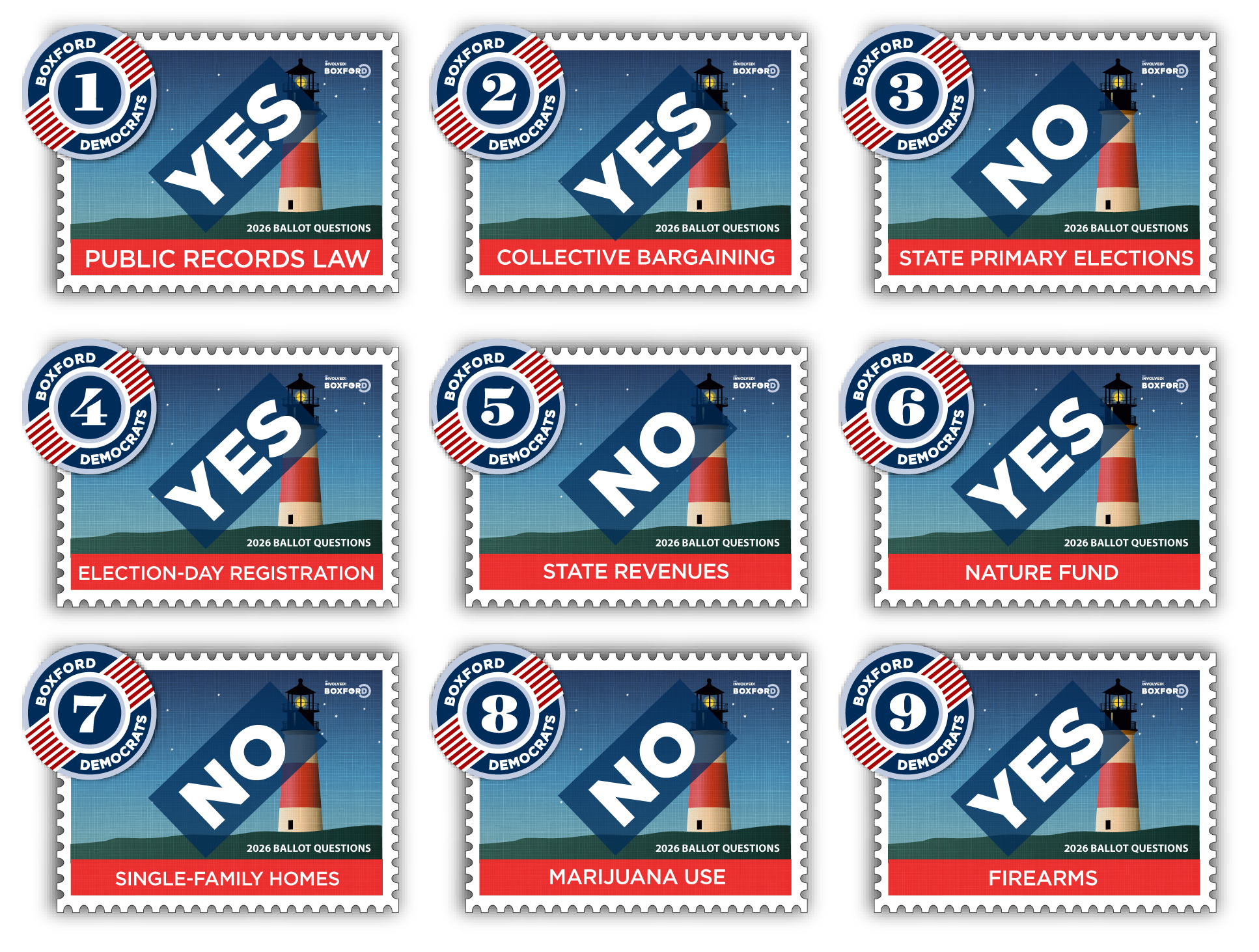
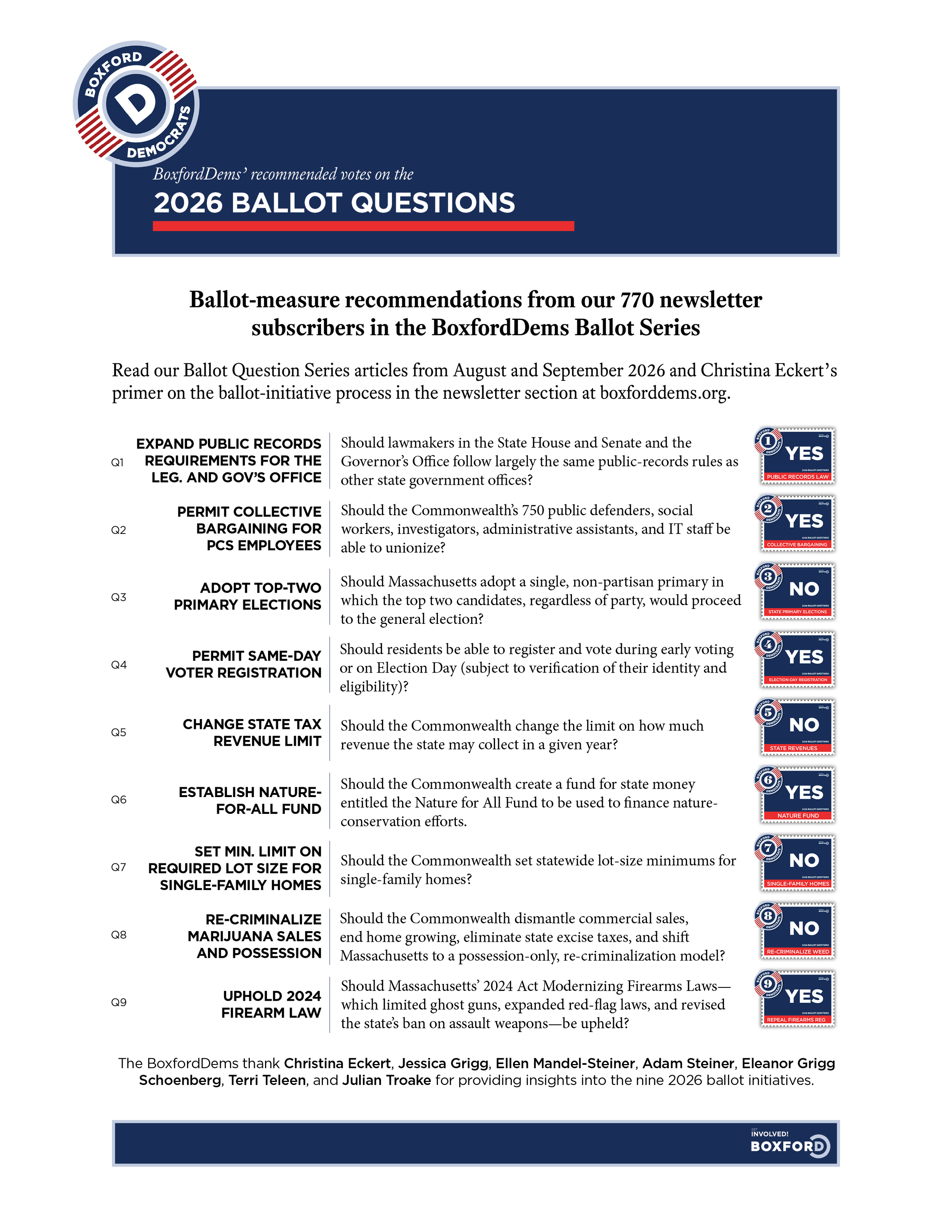
Q 1: Expanding the Public Records Law (Yes)
Q 2: Collective Bargaining for CPCS Employees (TBD)
Q 3: State Primary Elections (No)
Q 4: Election Day Registration (Yes)
Q 5: State Revenue Limit & Rebate (TBD)
Q 6: Natural-Resource Conservation Fund (Yes)
Q 7: Single Family Homes (TBD)
Q 8: Sale of Adult Recreational Use Marijuana (TBD)
Q 9: Firearms Regulation (TBD)
BoxfordDems Newsletter consensus votes are indicated in parentheses. They are made available as we publish the articles.
Drinks with Dems: Meet fellow Tri-Town Dems at Alfalfa Farm Cellars (Third Thursday of the Month)
Join our door-hanger initiative - get your neighbors involved!
BoxfordDems Blue Rides: We’re getting out the Boxford vote with Blue Rides
BoxfordDems Calendar: Organize, embed, and never miss another opportunity to get involved: crowd-sourcing calendar for the North Shore
Get Involved: Other great opportunities to get involved - nationwide