
Ballot 2026 Series


Change State Tax Revenue Limit Initiative
According to Ballotpedia, Question 5 would change the method of calculating the state tax revenue limit. Massachusetts has a state tax revenue limit that sets the maximum amount of tax revenue the state can collect in a given tax year. Any tax revenue collected by the state over the limit must be refunded to taxpayers the following year under a law known as Chapter 62F.
By Christina Eckert. Published Sept. 14, 2026.
Currently, the state tax revenue limit is equal to the sum of
the state tax revenue limit for the prior tax year, and
the average growth of wages and salaries in Massachusetts over the past three years, but
excludes revenue from the Fair Share Amendment, aka the millionaires’ tax (4% surtax on any income over $1 million).
Question 5 would change the method of calculating the limit so that it is equal to the sum of
the net amount of state revenue from the year prior, and
the average growth of wages and salaries in Massachusetts over the past three years, and
add Fair Share revenue to the calculation.
At a glance:What’s at stake?
Passing Question 5 would result in a decrease in the potential state tax revenue limit each year compared to the current system of calculating the limit.
What does this mean?
With the new calculation, tax revenue would likely exceed the state-tax revenue limit every year, which would result in rebates to taxpayers under Chapter 62F almost every year.
In theory, this sounds good, but it would severely limit the state budget, especially in areas of education and transportation. It would basically nullify the gains from the millionaires tax (which have paid for free school meals, community college, childcare, MBTA improvements, and more). Instead of these investments in infrastructure and education, millionaires would get their taxes back in huge rebates.
Breaking down your vote
Voting YES would recalculate the limit, send back rebates to taxpayers and severely limit the state budget.
Voting NO would leave the current calculation in place, and allow the state to continue to use the millionaires’ tax to fund education and transportation.
Pros/cons
Arguments in favor
This ballot question is backed by the conservative Massachusetts Taxpayers Foundation, which advocates for the state to give rebates back to taxpayers every year.
Arguments opposed
Protect Massachusetts' Future is leading the campaign in opposition to Question 5.[7] They say that Question 5 would negatively affect the government's ability to provide public services. A statement on their website says, "Together, these initiatives would force towns and cities across Massachusetts to lay off thousands of hard-working teachers, police officers, and firefighters, leaving families to pay the price for corporate greed. Hospitals, nursing homes, schools and colleges could be forced to close their doors, leaving us all worse off. These measures would strip billions of dollars from classrooms, hospitals, and research that Massachusetts communities depend on."[7]
The American Federation of Teachers Massachusetts also opposes the measure. Their statement on Question 5 says, "This ballot question would greatly diminish the impact of the Fair Share Amendment and go against the intention of this Constitutional Amendment by forcing the state to return surtax collections in times of high inflation and unemployment—times when our economy cannot withstand additional losses of revenue."[8]
Massachusetts Budget and Policy Center: "The ballot initiative would make the already flawed mechanism of the 62F law far more constraining over time.”
SEIU 509 “This would completely destabilize the workforce and destabilize the working infrastructure in Massachusetts. Seven billion dollars out of a $61 billion budget is devastating. It would completely upend the Massachusetts State House and what they do, and create chaos, and chaos isn’t good for business.”
The measure is also opposed by
1199SEIU
Massachusetts American Federation of Teachers (AFT)
Massachusetts Teachers Association
SEIU Massachusetts State Council
League of Women Voters of Massachusetts
Massachusetts Budget and Policy Center
Progressive Massachusetts
Deep dive
In 2022, Massachusetts had a $3 billion tax surplus and was ready to invest that in programs like the Student Opportunity Act, MBTA improvements, and more. Instead this surplus triggered Chapter 62F, sending checks back to taxpayers in proportion to what they paid with the average taxpayer receiving a refund of some $300, while millionaires got back tens of thousands.
The investments in education and transportation had to wait another year.
With this new law, 62F would be triggered almost every year. There would be no investments. Since there is not much in the state budget that is discretionary, the state would have to cut back on such spending – likely what it sends back to cities and towns for education, road repairs, and other local aid. So for that $300 income tax rebate, the average taxpayer would probably have to pay an increase in property taxes to cover the local loss of state aid.
When the state passed the Fair Share Amendment, there were predictions that it would send millionaires fleeing from Massachusetts. Instead, millionaires seemed to have stayed, and the revenue from this amendment has exceeded expectations of up to $2 billion per year; last year Fair Share revenue was nearly $3 billion. By law these monies must be invested in education and transportation. The Fair Share revenue has allowed Massachusetts to fully fund the Student Opportunity Act; offer free school lunches and breakfasts; offer free community college; subside childcare; make huge improvements to the MBTA, and offer free regional bus transportation. Lumping the millionaires’ tax in with regular revenue would lead to rebates to those same millionaires and few-to-no investments in education and transportation.
Not surprisingly, business groups are investing hundreds of thousands in the “Yes” campaign. The bigger the taxpayer, the bigger the refund. Millionaires get their Fair Share tax money back.
Polls currently show that this question will pass. People want those tax rebates, not realizing they’re going to lose services and pay more in the long run for schools and roads.
Estimated Breakdown by Income Tier
According to distributional analyses by organizations like the Massachusetts Budget and Policy Center, the proportional format meant that higher earners received much larger checks: [1]
Bottom 20% of Earners: Received an average of $9.
Middle-Income Taxpayers: Generally received anywhere from $150 to $500.
Top 1% of Earners: Received an average of over $22,000

ABOUT THE AUTHOR
Christina Eckert is a Boxford resident and Secretary of the Boxford Democratic Town Committee. She is also a legislative aide to Kristin Kassner, State Representative 2nd Essex District.
Author recommendation

Subscriber recommendation
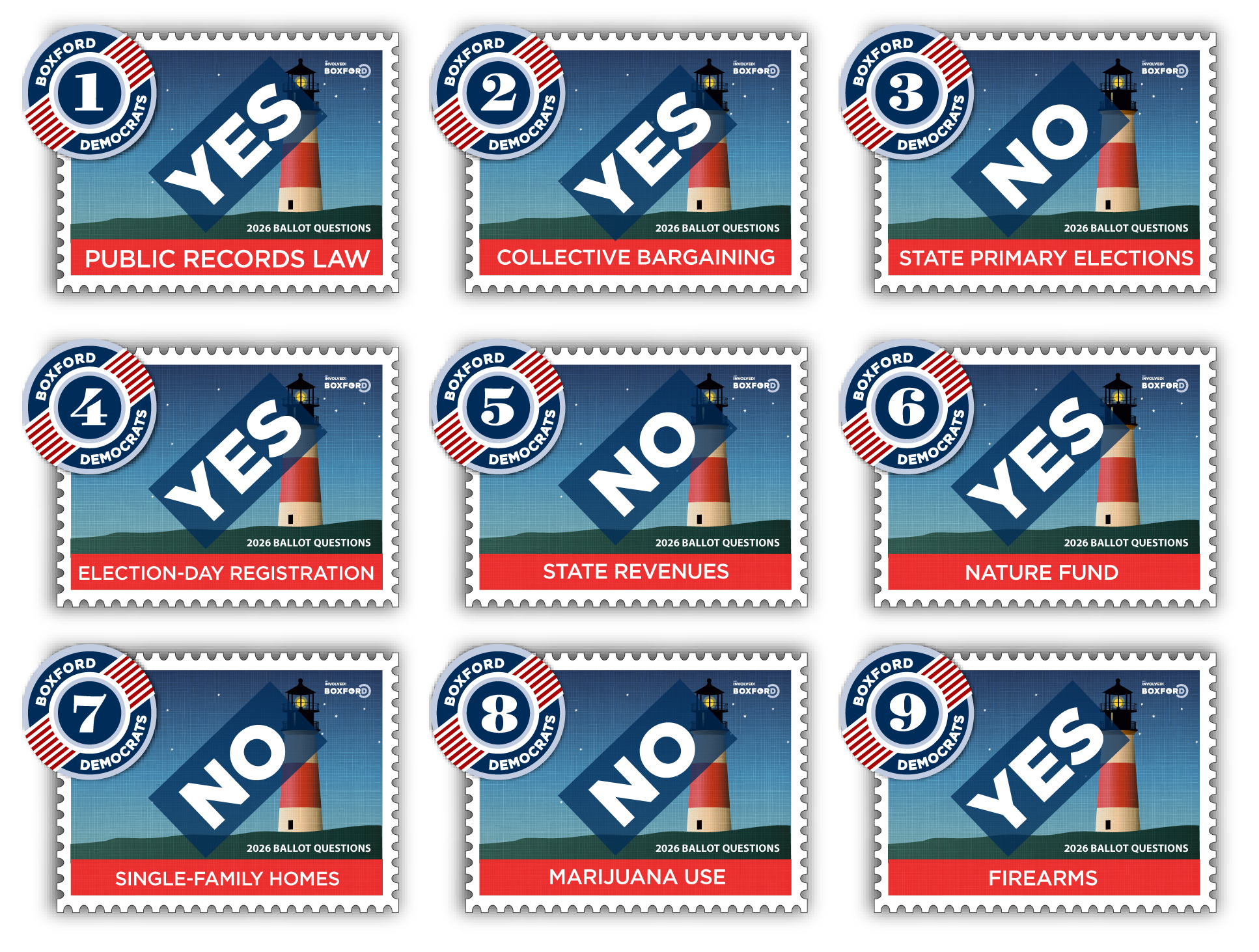
Ballot measure no. 5 earned a NO vote from our subscribers.
BoxfordDems Ballot-Measure Series
The BoxfordDems Ballot 2026 Series is our attempt at providing brief overviews of the various certified Massachusetts ballot initiatives as they pertain to our immediate region.
Overview of Ballot-Initiative Process (Christina Eckert)
Question 1
Expand Public Records Requirements for the Legislature and Governor’s Office? (Ellen Mandel)
Question 2
Permit Collective Bargaining for PCS Employees? (Christina Eckert)
Question 3
Adopt Top-Two State Primary Elections? (Terri Teleen)
Question 4
Permit Same-Day Voter Registration? (Eleanor Grigg Schoenberg)
Question 5
Change State Tax Revenue Limit Initiative? (Christina Eckert)
Question 6
Establish Nature-for-All Fund? (Jessica Grigg)
Question 7
Set Minimum Limit on Required Lot Size for Single-Family Homes? (Terri Teleen)
Question 8
Recriminalize Adult Recreational Use Marijuana? (Adam Steiner) (link)
Question 9
Uphold 2024 Act Modernizing Firearms Laws? (Julian Troake)
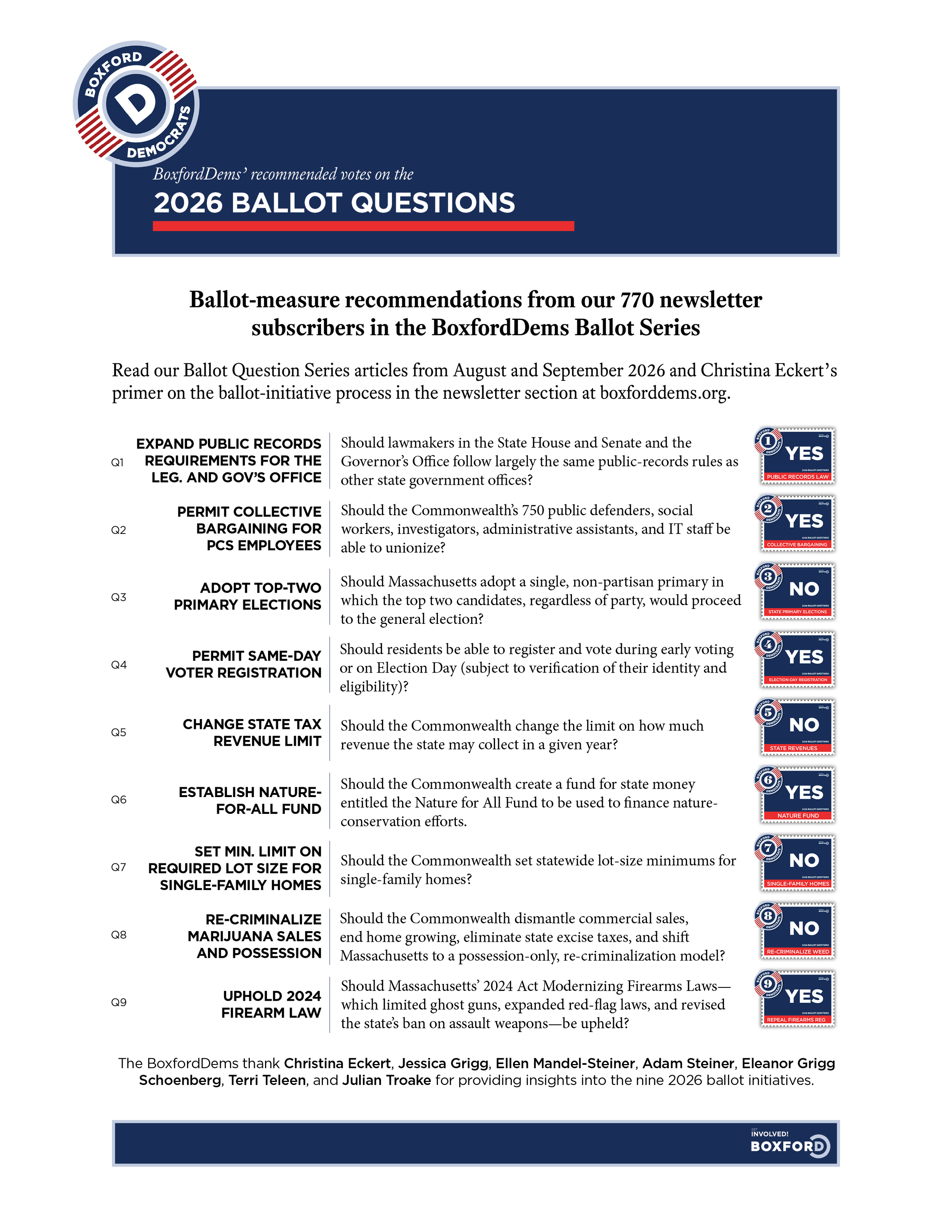
The graphic above represents our subscribers’ vote recommendations. The recommendations are also available as a PDF document, which is available for download here.
Opinions expressed in the series do not necessarily represent those of the Boxford Democratic Town Committee and should not be considered to be Committee endorsements of a particular policy or initiative. They are provided to promote healthy discussion and help voters make informed decisions at the ballot box