
Ballot 2026 Series

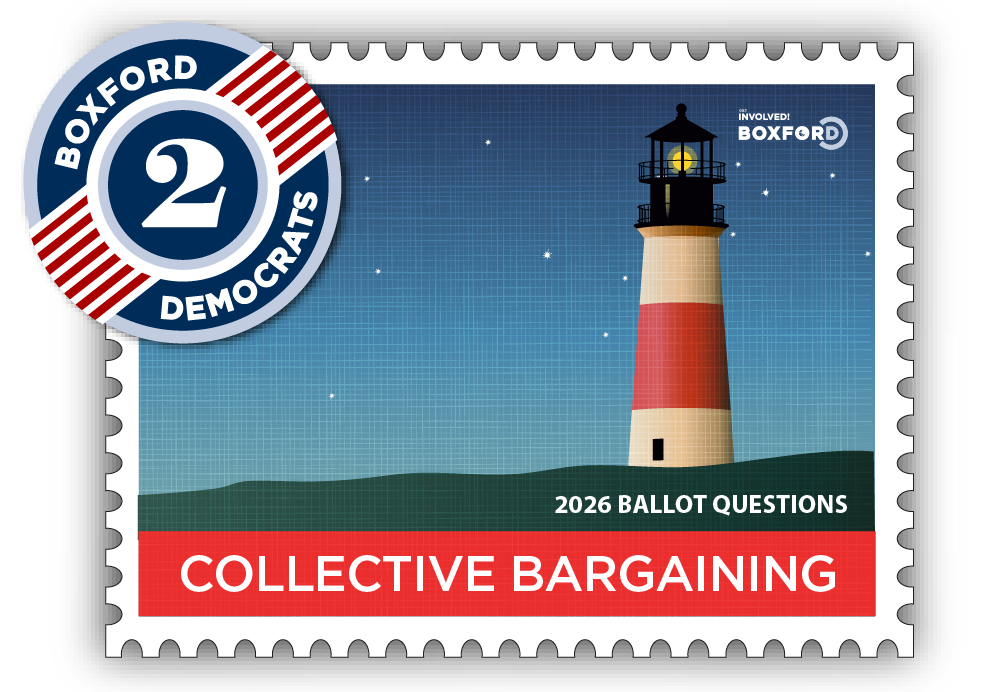

Collective Bargaining for Committee for Public Counsel Services Employees
Did you know that public defenders are currently legally unable to form a union?
By Christina Eckert. Published Aug. 24, 2026
According the Committee for Public Counsel Services (CPCS) own website, it
provides legal representation in Massachusetts for those unable to afford an attorney in all matters in which the law requires the appointment of counsel. This includes representation in criminal, delinquency, youthful offender, child welfare, mental health, sexually dangerous person and sex offender registry cases, as well as related appeals and post-conviction matters.
Currently public defenders do not have a union. This includes roughly 750 public defenders, social workers, investigators, administrative assistants, and IT staff.
Passing this ballot measure would change the Commonwealth’s collective-bargaining laws to formally define CPCS as a public employer, which would grant workers the same organizing rights as other state employees.
Deeper dive
A precipitating situation arose last year when bar-advocates effected a work stoppage last year, and CPCS lawyers picked up whatever slack they could. (Bar advocates are private lawyers who take indigent cases and are paid a minimal hourly rate—about $80—by the judiciary. They stopped taking cases last year and dozens if not hundreds of cases had to be thrown out because defendants were left without representation.)
The Legislature added additional funding in the state budget for CPCS to hire as many as 320 more lawyers to relieve the state’s dependence on bar advocates. Bar advocates would not be included in this union, but social workers, investigators, administrative assistants, and IT staff would be included.
Pros/Cons
ARGUMENTS IN FAVOR
This ballot question is backed by labor groups, including SEIU Local 888 and the National Association of Government Employees (NAGE).
Public defenders are facing overwhelming caseloads, which have knock-on effects relating to staff retention and workplace conditions.
This will allow public defenders to establish a formalized voice in agency funding and policies.
ARGUMENTS AGAINST
Currently there is no opposition to this ballot question..
Summary
Voting YES would
Allow Public Defenders to form a union
Require CPCS to submit any resulting contract to the governor's office for funding approval within 30 days of signing.
Voting NO would
Mean the Public Defenders cannot form a union.
Massachusetts voters will decide this initiative on November 3, 2026.

Author recommendation

ABOUT THE AUTHOR
Christina Eckert is a Boxford resident and Secretary of the Boxford Democratic Town Committee. She is also a legislative aide to Kristin Kassner, State Representative 2nd Essex District.
Subscribers weigh in

BoxfordDems Ballot-Measure Series
The BoxfordDems Ballot 2026 Series is our attempt at providing brief overviews of the various certified Massachusetts ballot initiatives as they pertain to our immediate region.
Overview of Ballot-Initiative Process (Christina Eckert)
Question 1
Expand Public Records Requirements for the Legislature and Governor’s Office? (Ellen Mandel)
Question 2
Permit Collective Bargaining for PCS Employees? (Christina Eckert)
Question 3
Adopt Top-Two State Primary Elections? (Terri Teleen)
Question 4
Permit Same-Day Voter Registration? (Eleanor Grigg Schoenberg)
Question 5
Change State Tax Revenue Limit Initiative? (Christina Eckert)
Question 6
Establish Nature-for-All Fund? (Jessica Grigg)
Question 7
Set Minimum Limit on Required Lot Size for Single-Family Homes? (Terri Teleen)
Question 8
Recriminalize Adult Recreational Use Marijuana? (Adam Steiner) (link)
Question 9
Uphold 2024 Act Modernizing Firearms Laws? (Julian Troake)
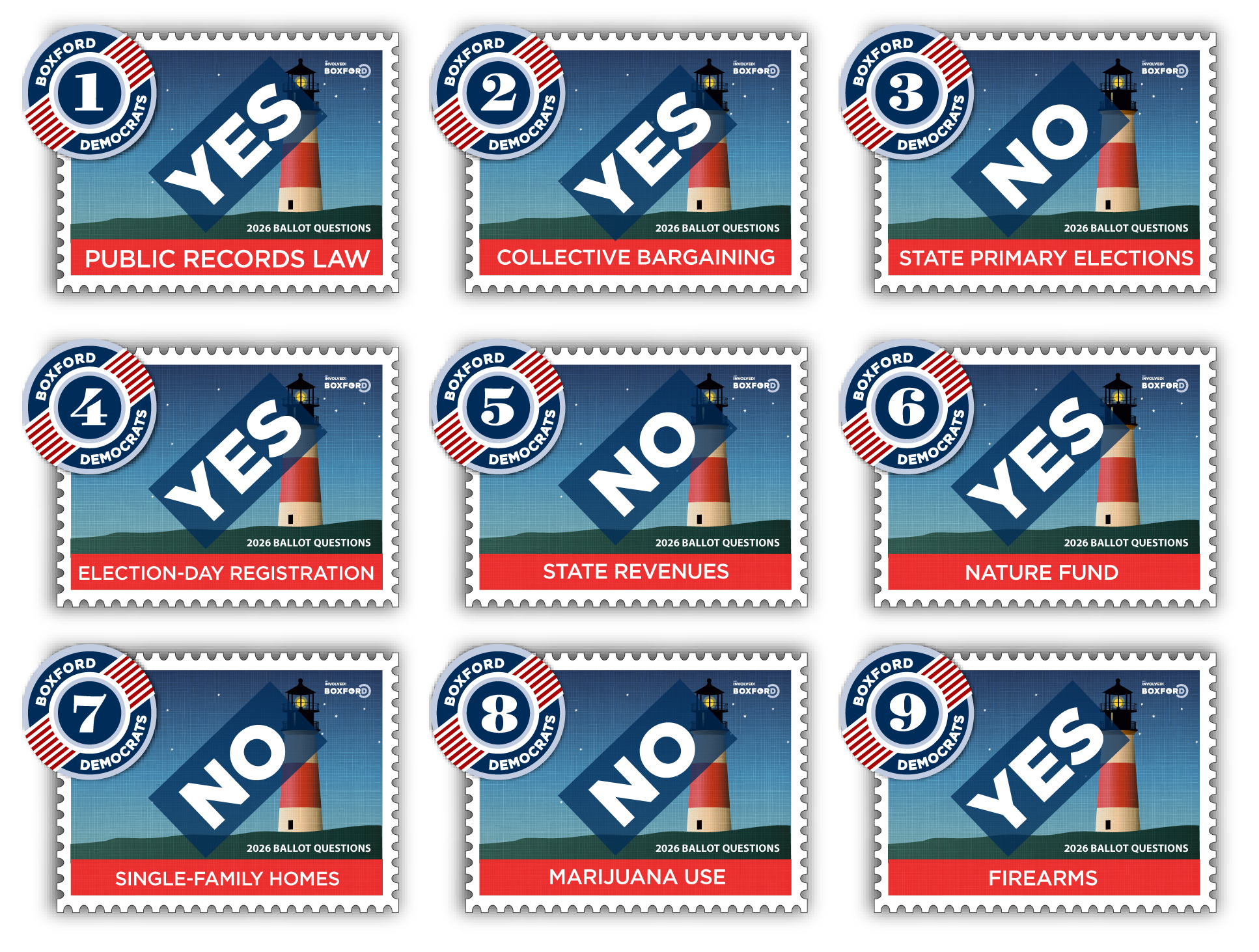
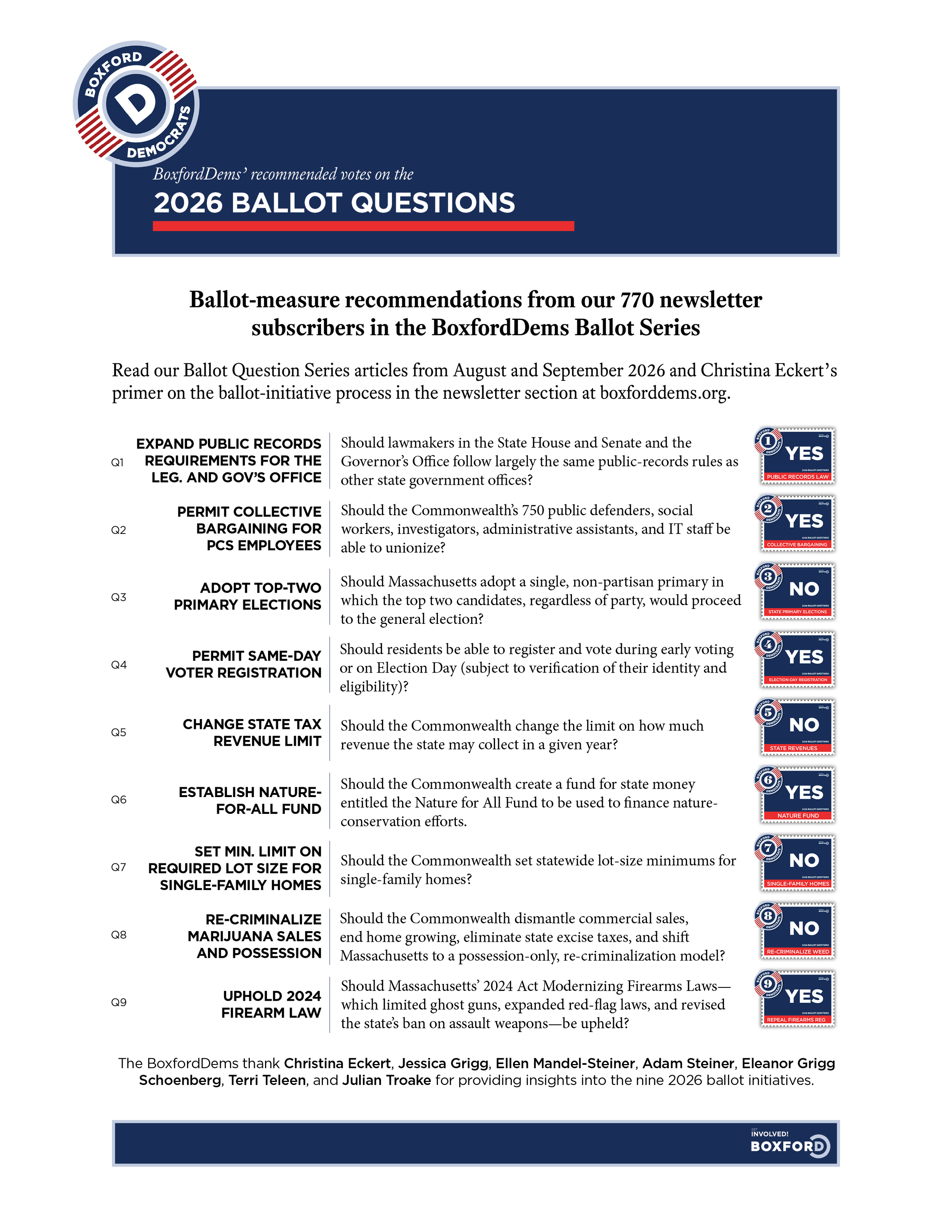
The graphic above represents our subscribers’ vote recommendations. The recommendations are also available as a PDF document, which is available for download here.
Opinions expressed in the series do not necessarily represent those of the Boxford Democratic Town Committee and should not be considered to be Committee endorsements of a particular policy or initiative. They are provided to promote healthy discussion and help voters make informed decisions at the ballot box