
Ballot 2026 Series


Limit on Required Lot Size for Single-Family Homes Initiative
If approved, the initiative would set statewide lot size minimums for single-family homes. It would require cities and towns to allow single-family homes on lots meeting the following criteria: minimum of 5,000 square feet (~ 1/9 acre) with 50 feet of frontage on a road and access to public water and sewer. All other local zoning rules—e.g., setbacks, wetlands rules, design standards, and parking requirements—would remain intact.
By Terri Teleen. Published Aug. 31, 2026.
The Limit on Required Lot Size for Single-Family Homes Initiative has officially qualified for the November 3, 2026 statewide ballot.
At a glance: What’s at stake?
Local zoning rules for single-family homes in many Massachusetts cities and towns require between 0.5 and 2 acres of land. Under this initiative, a statewide minimum (smaller) lot size would override local rules.
The initiative is backed by an unusual coalition of interest groups: pro-housing advocates, organizations representing the interests of realtors and residential developers, and academic economists.
Breaking down your vote
A yes vote would require cities and towns—except the City of Boston—to allow construction of single-family dwellings on lots that are smaller than current, local regulations allow. A lot must meet several criteria, including access to public water and sewer; and in practical terms, Boxford would not be impacted.
Pros/Cons
ARGUMENTS IN FAVOR
Supporters frame the initiative as a targeted way to expand housing supply and affordability.
They argue that smaller lot sizes will make homeownership more affordable and feasible for first-time buyers, seniors, and others who currently struggle to afford a home. The measure would apply only where water and sewer already exist, thereby focusing growth in areas where such services are available.
ARGUMENTS AGAINST
Detractors, including organizations representing municipal administrators, cite loss of local control.
They argue that land-use regulations should be in the hands of local cities and towns, and that state-wide rules present a risk of strain on planning and local resources and infrastructure.
National perspective
Scholars spend entire careers studying the history and impact of local control of residential land in the U.S. The consensus among researchers is that large minimum lot sizes were driven in large part by efforts to self-segregate by race and class.
For background information on residential zoning in this area, see Exclusionary by Design: An Investigation of Zoning’s Use as a Tool of Race, Class, and Family Exclusion in Boston’s Suburbs, 1920 to Today (Boston Indicators, November 2023).
Land-use reform is a topic of discussion across the country. The NYU Furman Center has a tool that maps land use reform initiatives by state.
Summary
A “Yes” vote supports a state regulation that will override local land-use regulations as they pertain to single-family dwellings. Note that Boxford would not be impacted by the regulation because we lack the required infrastructure (public water and sewer).
A “No” vote would allow cities and towns to continue to make their own zoning requirements for single-family dwellings.
Massachusetts voters will decide the fate of the initiative on November 3, 2026.

ABOUT THE AUTHOR
Terri Teleen is a Boxford resident and Vice Chair of the Boxford Democratic Town Committee.
Author recommendation
I struggled with my response to this initiative. It addresses only one piece of a much broader set of reforms that would be required to make Massachusetts a more equitable place.
In May, the New York Times Editorial Board expressed its support for this initiative. Opinion | How to Legalize Starter Homes - The New York Times:
Currently, many Massachusetts towns require house lots to be at least 20,000 square feet, which is larger than most midsize supermarkets, like Trader Joe’s. Nationwide, only about one-fifth of homes are built on such large plots. It is a minimum that caters to the affluent.
The initiative would create a statewide minimum of 5,000 square feet, which is about the size of a basketball court, and bar towns from setting their own standards. The policy would enable the construction of more homes that young families and other members of the middle class could afford.
We recognize that many homeowners are wary of allowing more construction. They like their neighborhoods as they are and want to maximize their home values. These skeptics tend to be older and richer, with the time and resources to attend town meetings and criticize plans for new development. Yet if the United States has any chance to reduce wealth inequality, increase economic mobility and help more people achieve the American dream, it needs significantly more housing. Blue states like Massachusetts need to be part of the solution.
Making home ownership more affordable is one element of a broader set of reforms that will be required to usher in a more just, equitable society.
The measure does not guarantee that homes on smaller lots will indeed be more affordable. It does not change the fact that builders, banks, and consumers value houses that are bigger and more luxurious over houses that are more modest and environmentally sustainable. As a Boxford resident, I can have my cake and eat it too; I realize I can care about equity without worrying that the lots next to mine will be subdivided — and I’m fully aware that everyone doesn’t have that luxury.
Still, on balance, I think this initiative is worthy of support.

Subscribers weigh in


BoxfordDems Ballot-Measure Series
The BoxfordDems Ballot 2026 Series is our attempt at providing brief overviews of the various certified Massachusetts ballot initiatives as they pertain to our immediate region.
Overview of Ballot-Initiative Process (Christina Eckert)
Question 1
Expand Public Records Requirements for the Legislature and Governor’s Office? (Ellen Mandel)
Question 2
Permit Collective Bargaining for PCS Employees? (Christina Eckert)
Question 3
Adopt Top-Two State Primary Elections? (Terri Teleen)
Question 4
Permit Same-Day Voter Registration? (Eleanor Grigg Schoenberg)
Question 5
Change State Tax Revenue Limit Initiative? (Christina Eckert)
Question 6
Establish Nature-for-All Fund? (Jessica Grigg)
Question 7
Set Minimum Limit on Required Lot Size for Single-Family Homes? (Terri Teleen)
Question 8
Recriminalize Adult Recreational Use Marijuana? (Adam Steiner) (link)
Question 9
Uphold 2024 Act Modernizing Firearms Laws? (Julian Troake)
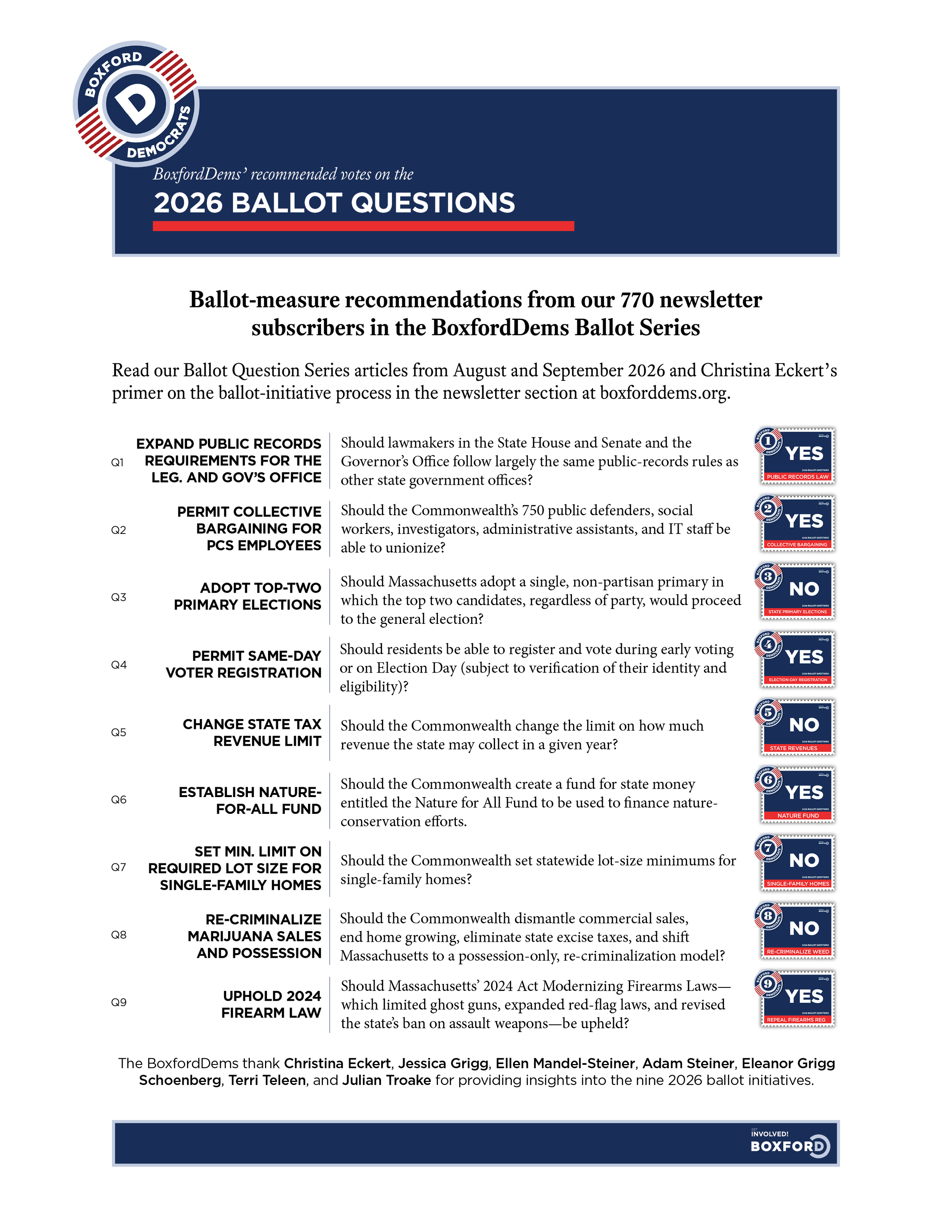
The graphic above represents our subscribers’ vote recommendations. The recommendations are also available as a PDF document, which is available for download here.
Opinions expressed in the series do not necessarily represent those of the Boxford Democratic Town Committee and should not be considered to be Committee endorsements of a particular policy or initiative. They are provided to promote healthy discussion and help voters make informed decisions at the ballot box